





Solutions - Corporate IP Teams

PATENT PORTFOLIO MONETIZATION INTELLIGENCE FOR CORPORATE IP TEAMS

PatentsKart helps corporate IP teams identify hidden licensing, technology-adoption, potential-enforcement and strategic-leverage opportunities across large portfolios. We rank the strongest signals and prepare the technical, evidence, risk and commercial package needed for management, counsel, funder or commercial review.

Large Portfolios Create More Possibilities Than Most Teams Can Review

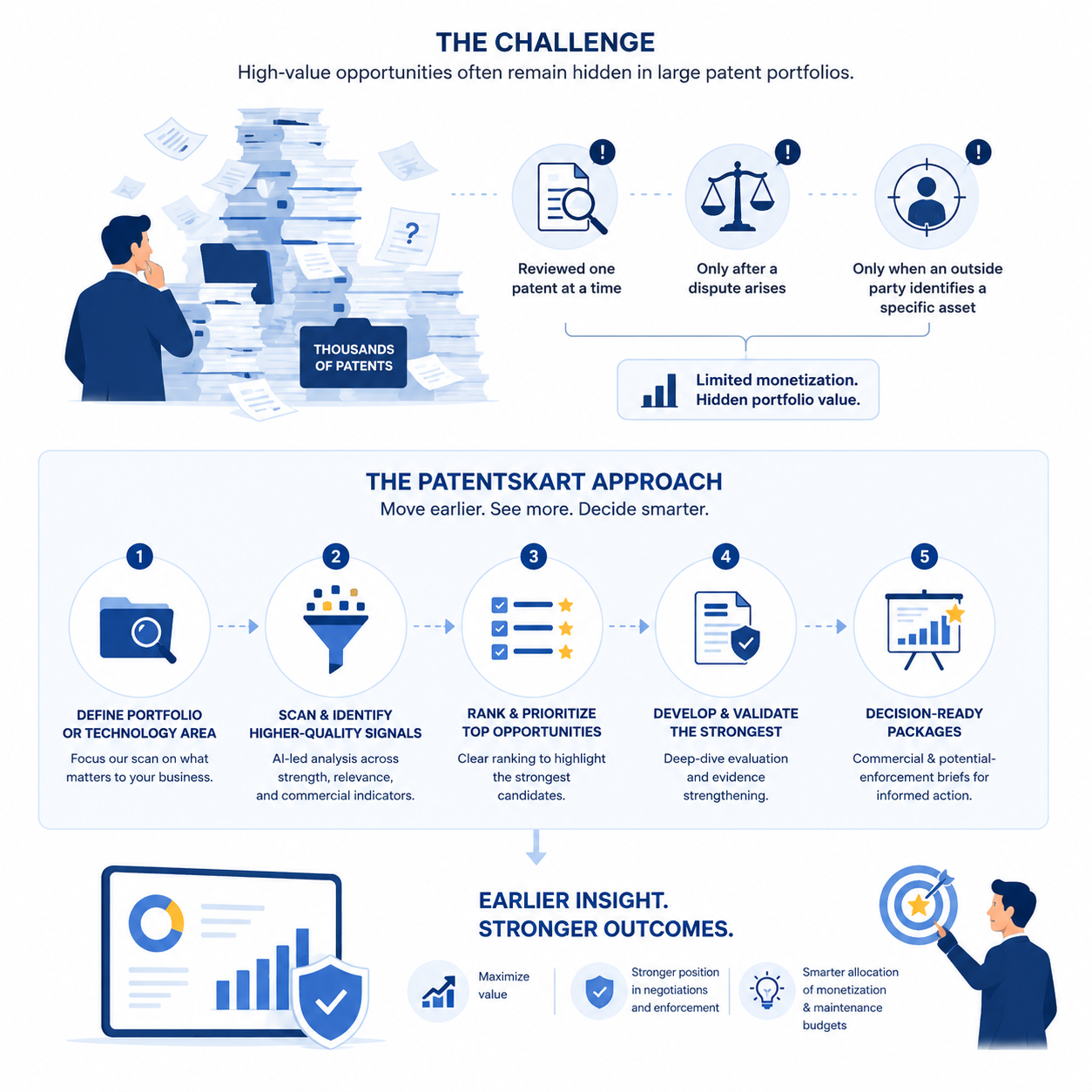
Corporate IP teams often manage thousands of patents, multiple business units and limited monetization or maintenance budgets. Potential value may remain hidden because the portfolio is reviewed one patent at a time, after a dispute arises, or only when an outside party identifies a specific asset.

PatentsKart helps move the process earlier. We scan defined portfolios or technology areas, identify higher-quality signals, rank them, and develop the strongest candidates into decision-ready commercial and potential-enforcement packages.

Focused Solutions for Opportunity Discovery and Qualification

Portfolio Monetization Audit

Identify and rank licensing, technology-adoption, potential-enforcement and strategic-leverage opportunities across a selected portfolio or technology area.

Cross-assertion and negotiation support

Identify assets that may strengthen cross-licensing, settlement, counter-assertion, supplier/customer or broader commercial negotiations.

Licensing opportunity pipeline

Identify specific companies, products and business units with stronger technical and commercial relevance, then develop product-specific licensing packages.

Potential-enforcement opportunity pipeline

Surface patent-to-product signals, filter weak candidates, and prepare the strongest matters for counsel or funder review.

Portfolio Ranking, Pruning & Maintenance

Support maintenance-fee, pruning, continuation, prosecution-investment, sale and licensing decisions using technical, market and opportunity evidence.

Continuous opportunity monitoring

Track product launches, feature changes, market entry, ownership and prosecution developments that may change opportunity relevance.

Transaction and due-diligence support

Assess commercial opportunity signals within portfolios being acquired, divested, licensed, sold or evaluated in a strategic transaction.

Ranking and decision language

b9de5b97-71b8-4a3e-9e24-219f42fbce79

Traditional corporate workflow

  • Portfolio review begins only after a specific patent is selected.
  • Different teams receive broad lists, dashboards or disconnected reports.
  • Counsel time is used to screen many weak candidates.
  • Maintenance decisions rely heavily on age, cost or internal business-use data.
  • Cross-assertion assets are searched reactively after a dispute begins.
  • Potential matches are reviewed once and then forgotten.

cea0ae22-a6fe-420d-aab1-8754b5815a7d

Improved workflow with PatentsKart

  • Begin with a portfolio, technology, competitor or product question and identify the relevant candidates.
  • Receive one ranked pipeline with evidence, gaps, risk, commercial relevance and next actions.
  • Filter and package the strongest candidates before substantial legal resources are committed.
  • Add product, market, licensing, enforcement and monitoring signals to the maintenance decision.
  • Maintain a more structured view of portfolio assets relevant to competitors, products and negotiation scenarios.
  • Monitor defined signals and update the opportunity when product, legal or market conditions change.

Corporate deliverables

  • Portfolio opportunity heat map showing high-, medium-, low-priority and monitor candidates, with reasons for each ranking.
  • Shortlist of patents, products, companies and business units that merit deeper licensing, enforcement or strategic review.
  • Decision-ready package for the strongest candidates, including evidence, gaps, ownership/status, preliminary risk and commercial relevance.
  • Recommended route: licensing, technology adoption, potential enforcement, cross-assertion, sale, monitoring, maintenance, pruning or no further action.
  • Defined next-action plan for internal stakeholders, outside counsel, inventors, technical experts or commercial teams.
  • Optional recurring watchlist tracking products, companies and portfolio signals that may create new opportunities.

How the work integrates with corporate workflows

IP portfolio committee

Provides a prioritized opportunity and portfolio-optimization view for periodic review.

Licensing team

Supplies qualified counterparties, product evidence, opportunity thesis and engagement route.

Litigation team / outside counsel

Provides organized technical and commercial groundwork for legal assessment.

Finance / strategy / corporate development

Provides commercial context for licensing, acquisition, sale or negotiation decisions.

Annuity / maintenance review

Adds market and opportunity evidence to renewal, pruning and prosecution-investment decisions.

Existing IPMS and analytics platforms

PatentsKart can use client-selected data and work downstream of existing platforms; it does not require a platform replacement.

Find the Highest-Value Questions Hidden in Your Portfolio

Bring us one portfolio, technology area, competitor or maintenance cohort. We will help determine the right starting point and define a focused pilot.

FAQs

No. Licensee Finder identifies organizations that may have technical and commercial relevance to selected patents based on publicly available information. Final licensing decisions require expert evaluation and business assessment.

Licensee Finder evaluates patent portfolios alongside publicly available company information, products, technologies, industries, and market intelligence to identify potential licensing opportunities.

Yes. The insights can help prioritize organizations for licensing discussions, technology transfer initiatives, commercialization programs, and portfolio monetization strategies.

Promising opportunities can be further assessed by PatentsKart specialists through technical review, commercial evaluation, ownership analysis, and licensing strategy support before engagement decisions are made.