





Solutions - Litigation Funders, Investors and Advisers

PATENT OPPORTUNITY DILIGENCE FOR LITIGATION FUNDERS AND INVESTORS

PatentsKart helps litigation funders, investors, valuation professionals and monetization advisers source potential opportunities and independently assess the technical evidence, material gaps, patent position, preliminary risk and commercial significance of opportunities already under review.

A Promising Claim Chart Is Only One Part of a Funding Decision

Focused Solutions for Opportunity Discovery and Qualification

Opportunity sourcing

Identify potential monetization and enforcement candidates through portfolio-led or target-led reviews.

Independent technical assessment

Validate claim-to-product evidence, product versions, actors, systems and material unsupported limitations.

Patent-position review

Summarize ownership, assignment, family, legal status, remaining term and preliminary standing-related observations, subject to counsel verification.

Commercial significance

Assess target importance, product relevance, market position and whether the opportunity appears commercially meaningful.

High-level economic inputs

Organize publicly available revenue, marking, product and damages-related inputs for qualified expert and counsel review.

Ongoing opportunity monitoring

Track product, legal, ownership and market developments affecting an opportunity under review.

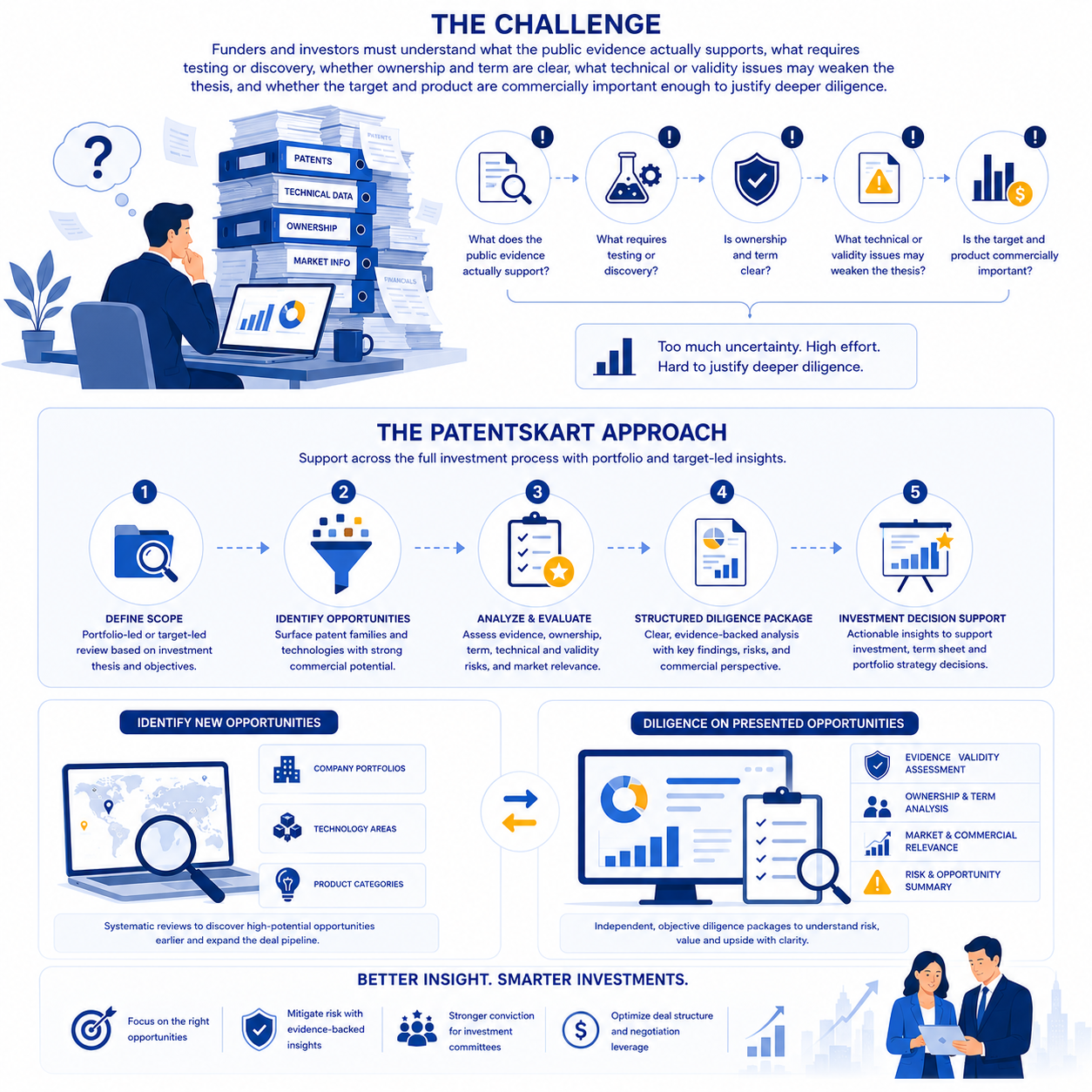
From fragmented diligence to decision-ready opportunity assessment

PatentsKart helps investment and diligence teams surface weak assumptions earlier, connect workstreams, and define the next decision before deeper resources are committed.

Traditional Diligence Workflow

1

Start with the advocacy narrative

The matter arrives with a claim chart and advocacy narrative.

2

Workstreams stay disconnected

Technical, legal, ownership and commercial workstreams are reviewed independently.

3

Full diligence starts too early

Full diligence begins before the weakest assumptions are identified.

4

Sourcing stays reactive

Opportunity sourcing depends on intermediaries or inbound matters.

5
?

The next decision stays unclear

The result is often a general view that more diligence is needed.

6

Changes are tracked informally

Developments after review are tracked informally.

Improved Workflow with PatentsKart

Separate evidence from assumptions

Receive a structured evidence-and-gap assessment separating support, assumptions and open questions.

Connect every diligence workstream

Use one diligence map showing how technical, legal, ownership and commercial workstreams affect the investment decision.

Triage before deeper spend

Apply an early triage package to determine whether deeper counsel, expert, testing or damages work is justified.

Source opportunities proactively

Use target-led or portfolio-led identification to source additional candidates under defined criteria.

End with a defined decision path

Receive a defined list of remaining issues, responsible workstream and recommended decision status.

Keep the thesis current

Monitor product, ownership, litigation, prosecution and market developments that affect the thesis.

Find the weak assumptions earlier. Commit deeper resources with more confidence.

PatentsKart creates a structured path from initial evidence to triage, diligence, decision and ongoing monitoring.

b9de5b97-71b8-4a3e-9e24-219f42fbce79

Traditional TTO workflow

  • The matter arrives with a claim chart and advocacy narrative.
  • Technical, legal, ownership and commercial workstreams are reviewed independently.
  • Full diligence begins before the weakest assumptions are identified.
  • Opportunity sourcing depends on intermediaries or inbound matters.
  • The result is a general view that more diligence is needed.
  • Changes after review are tracked informally.
cea0ae22-a6fe-420d-aab1-8754b5815a7d

Improved workflow with PatentsKart

  • Receive a structured evidence-and-gap assessment separating support, assumptions and open questions.
  • Use one diligence map showing how the workstreams affect the investment decision.
  • Apply an early triage package to determine whether deeper counsel, expert, testing or damages work is justified.
  • Use target-led or portfolio-led identification to source additional candidates under defined criteria.
  • Receive a defined list of remaining issues, responsible workstream and recommended decision status.
  • Monitor product, ownership, litigation, prosecution and market developments that affect the thesis.

Funder and investor deliverables

  • Executive opportunity and investment-readiness snapshot.
  • Patent, family, ownership, status and remaining-term summary.
  • Target, product, product-version and market profile.
  • Claim-to-product evidence and material gap map.
  • Actor, system, testing, source-code and discovery requirements.
  • Preliminary prior-art, eligibility and enforcement-risk observations.
  • Commercial significance and publicly available high-level economic inputs.
  • List of issues requiring counsel, technical experts, damages experts, testing or additional documents.
  • Funding-stage recommendation and decision status.
  • Optional ongoing watchlist for material changes.

How the work integrates with funder and investor workflows

Initial opportunity intake

Provides an early independent screen before full external diligence is commissioned.


Technical diligence

Organizes evidence, product versions, unsupported limitations and technical validation requirements.

Counsel diligence

Provides a structured factual package for legal review without replacing legal opinions.

Damages and valuation experts

Organizes publicly available product, revenue, marking and commercial inputs for specialist analysis.

Investment committee

Provides a concise opportunity, risk, gap and next-action summary.


Ongoing portfolio monitoring

Tracks changes that may affect funded or monitored opportunities.

Decide Where Deeper Diligence and Capital Are Justified

Bring us one proposed matter, portfolio acquisition, target company or sourcing question. We will help define the appropriate technical and commercial diligence pilot.

FAQs

Yes. PatentsKart can provide an independent technical and commercial assessment that separates supported evidence, open questions, preliminary risk and required next steps.

Yes. Portfolio-led and target-led reviews can identify potential candidates under criteria defined with the funder or adviser.

No. PatentsKart prepares technical, evidence, ownership/status and commercial groundwork. Counsel remains responsible for legal opinions, strategy and privilege decisions.

The review can address product versions, system architecture, actors, claim-feature evidence, unsupported limitations, testing needs, source-code needs and discovery requirements.

Yes. Preliminary prior-art and eligibility observations can identify questions requiring deeper counsel or expert review. They are not legal opinions.