
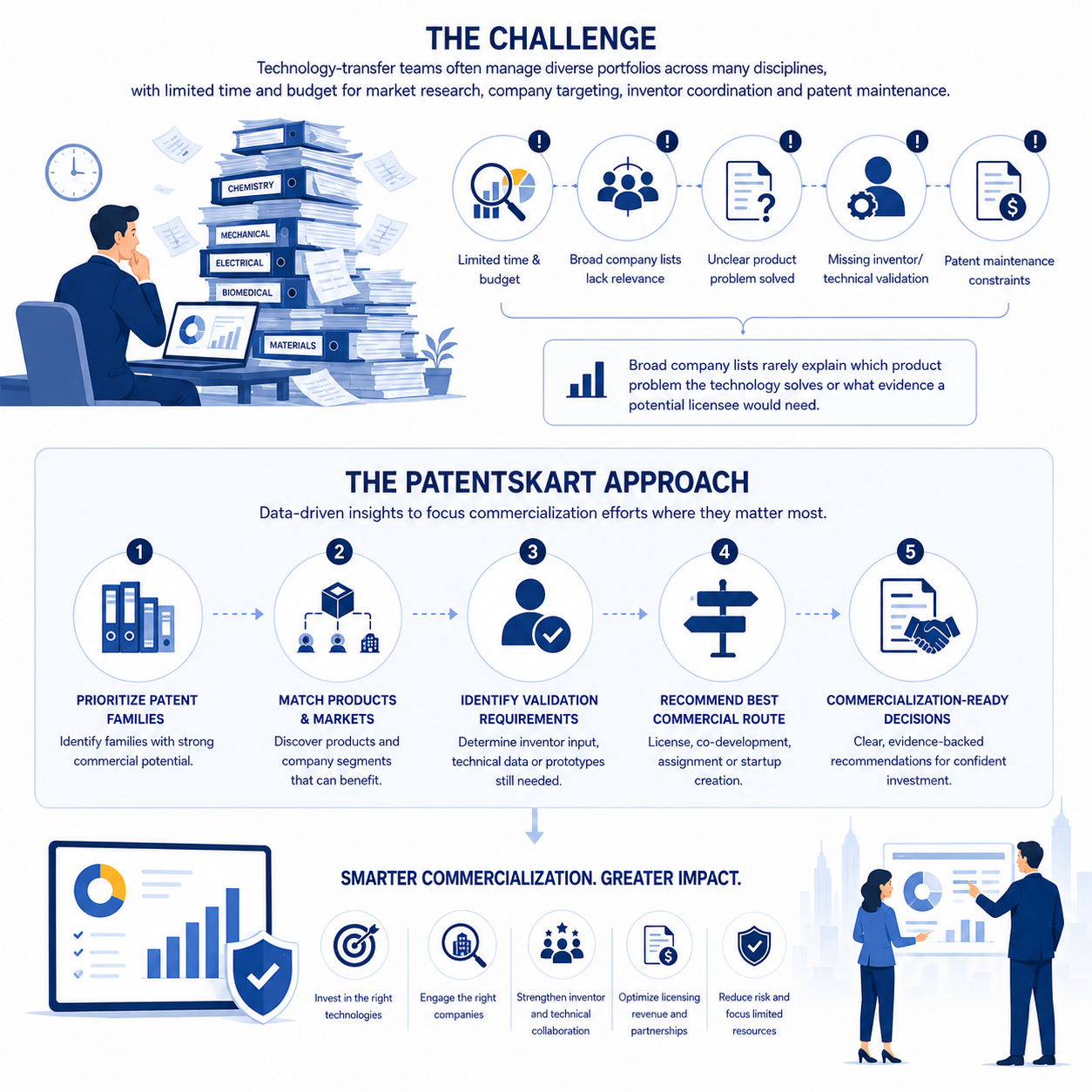






PatentsKart helps universities and technology-transfer teams prioritize diverse patent portfolios, identify companies and products that may benefit from patented technologies, and develop clear licensing, technology-adoption and collaboration packages within limited commercialization budgets.
Rank patent families based on product relevance, market activity, technical maturity, validation readiness and commercialization potential.
Identify assets that may strengthen cross-licensing, settlement, counter-assertion, supplier/customer or broader commercial negotiations.
Identify specific companies, products, business units and technical gaps that may align with the patented technology.
Where appropriate, identify signals for further university and qualified-counsel review without presenting a legal conclusion.
Explain the product problem, patented improvement, potential technical benefit, integration considerations and commercial rationale.
Track companies, products, technology trends and market developments that may create future licensing relevance.
PatentsKart helps technology transfer teams prioritize stronger opportunities, identify relevant licensees, and connect commercialization evidence to portfolio decisions.
Large portfolios are reviewed mainly based on inventor interest, age or ad hoc inquiries.
Potential licensee searches produce broad company lists without enough product-level context.
The invention is described primarily through patent language.
Inventor involvement is requested without a defined question set.
Maintenance decisions are separated from commercialization evidence.
Promising technologies are reviewed once and then become inactive.

Add product, company, technical and market evidence to prioritize commercialization resources.
Identify specific products, business units, product gaps and reasons the company may care.
Translate the patent into a product problem, improvement thesis and adoption rationale.
Provide a focused inventor-validation plan tied directly to the opportunity thesis.
Use opportunity and market evidence to support renewal, pruning and prosecution-investment decisions.
Maintain a watchlist for new products, partnerships, market changes and potential licensee developments.
PatentsKart helps TTO teams connect portfolio strategy, market evidence and licensee discovery in one structured commercialization workflow.
Adds early market, product and company questions to the technical review.
Provides ranked commercialization and maintenance recommendations.
Supplies product-specific target rationales and engagement routes.
Provides focused validation questions rather than broad requests for more information.
Identifies evaluation, sponsored-research, joint-development and strategic-collaboration pathways.
PatentsKart can provide structured outputs for the TTO’s current tracking system and does not require replacing it.
Yes. For early-stage technologies, the deliverable should focus on product need, technical value, validation requirements, inventor input and evaluation or collaboration pathways rather than forcing an immediate licensing conclusion.
Yes, but the work should be phased by technology cluster or commercialization priority so the ranking criteria and outputs remain meaningful.
Yes. Product, market, target and opportunity evidence can be combined with the TTO’s legal, technical and budget considerations to support renewal and pruning decisions.
Where appropriate, potential product relevance may be flagged for university and qualified-counsel review. PatentsKart does not provide a legal infringement opinion.
Start with one patent family or one technology cluster and define the commercial question the TTO needs to answer.